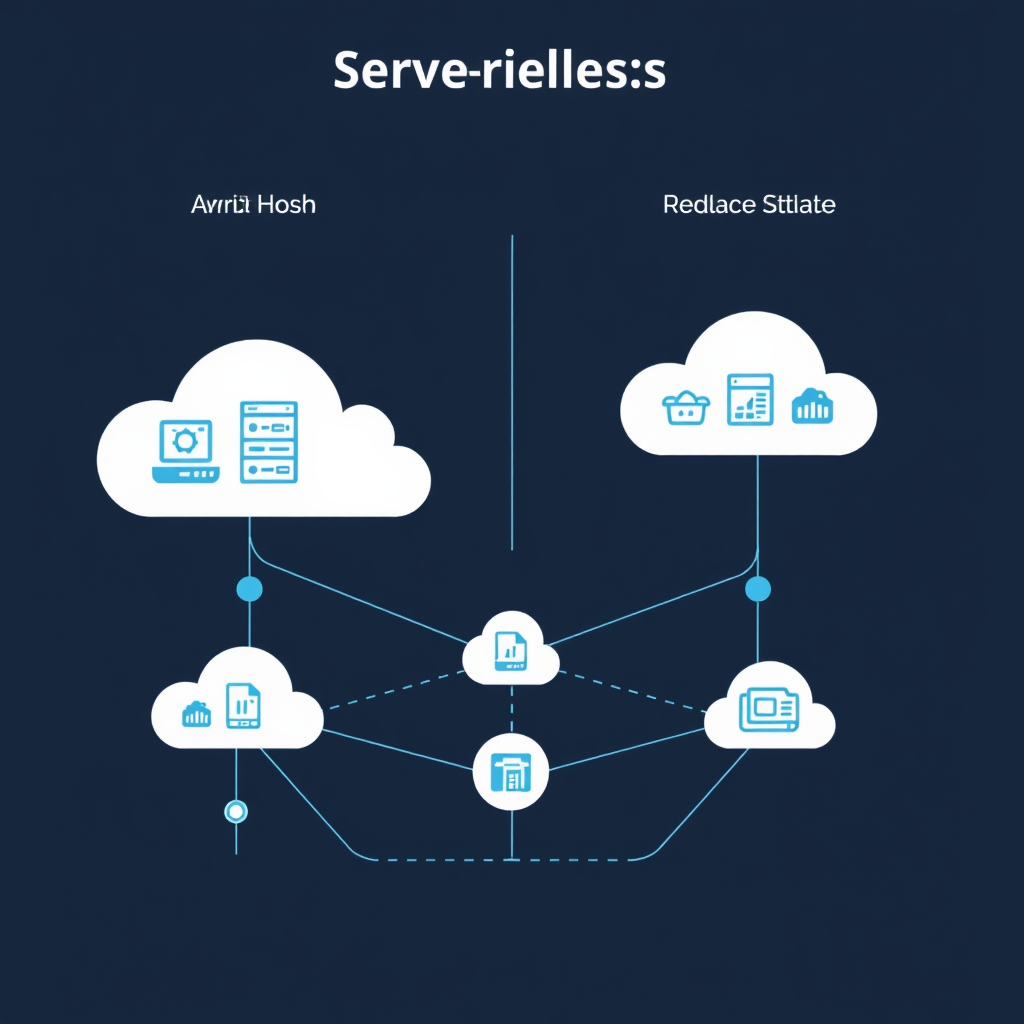
Serverless architecture represents a fundamental shift in how we think about web hosting and application deployment. Moving beyond traditional hosting models, serverless computing allows developers to build and run applications without managing servers directly, paying only for the actual compute time used.
The journey from traditional hosting to serverless has been driven by several key factors. Traditional hosting models like shared hosting, VPS, and even dedicated servers require administrators to manage and maintain infrastructure, handle updates, and worry about scalability. As applications grow more complex and traffic patterns become more unpredictable, the limitations of traditional hosting become apparent.
The Evolution of Hosting Models
Traditional hosting has evolved through several stages, each addressing some of the limitations of its predecessor:
- Shared Hosting: Multiple websites share server resources, offering affordability but limited control and scalability.
- VPS Hosting: Virtual private servers provide dedicated resources within a shared infrastructure, offering better control but still requiring server management.
- Dedicated Servers: Full server control with dedicated resources, but requires complete infrastructure management.
Each step represented progress toward more control and autonomy, but also introduced new complexities in terms of management overhead and infrastructure maintenance.
Serverless: The Game-Changer
Serverless computing completely eliminates the need to provision or manage servers. Instead of maintaining infrastructure, developers focus purely on writing code that executes in response to events or HTTP requests. The platform handles scaling, maintenance, and resource allocation automatically.
Key Benefits of Serverless Architecture
- Cost Efficiency: Pay only for actual compute time, with most providers offering generous free tiers.
- Scalability: Automatically scales to handle any amount of traffic, from zero requests to millions.
- Developer Focus: No infrastructure management, allowing developers to focus on business logic.
- Global Reach: Built-in geographic distribution through edge locations.
- Continuous Innovation: Providers handle updates, security patches, and feature additions.
Common Challenges and Limitations
While serverless offers compelling benefits, it also introduces new considerations that require careful planning:
- Cold Starts: Initial request latency when functions haven’t been recently executed.
- Vendor Lock-In: APIs and services vary between providers, making migration complex.
- Debugging Complexity: Distributed nature can make debugging more challenging.
- State Management: Functions are stateless, requiring external storage for persistent data.
- Performance Variability: Execution time depends on provider infrastructure and geographic location.
Understanding these limitations helps in making informed decisions about when and how to use serverless architecture in your applications.
Getting Started with Serverless
If you’re considering serverless for your web application, start with a simple proof of concept. Begin by moving a non-critical feature or API endpoint to serverless, then gradually expand your serverless footprint as you gain experience.
Most major cloud providers offer generous free tiers for serverless functions, making it easy to experiment without immediate cost concerns. As your application matures, you can optimize for cost and performance based on actual usage patterns.
The transition from traditional hosting to serverless represents not just a technical change, but a fundamental shift in how we think about building and operating web applications. It’s an evolution that continues to reshape the web development landscape and will likely become the standard approach for most modern web services.
Leave a Reply